Not all transport damage is immediately visible
High-quality cargo appears to arrive at its destination undamaged—no dents, no scratches, no obvious defects. Yet hidden damage may already have occurred inside.
Even a brief shock or a slight temperature fluctuation can displace or damage sensitive components—often without causing any external damage. The result: time-consuming troubleshooting, unplanned repairs, or costly downtime.
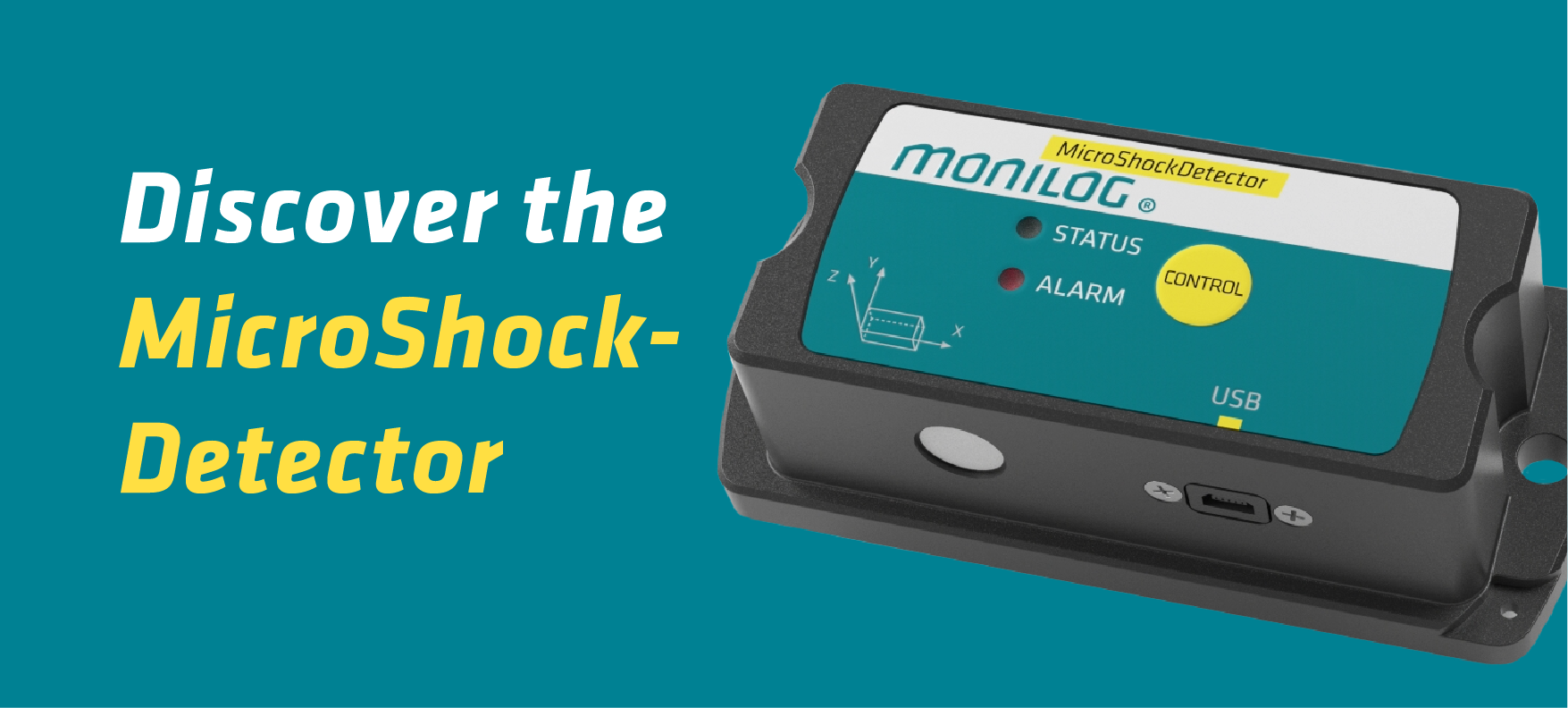
This is exactly where the MicroShockDetector comes in.
As the smallest shock recorder in the Monilog® product portfolio, it reliably documents transport events and, thanks to a shock sensor and a temperature sensor, ensures transparency throughout the entire transport route.
The Great Benefits of the Small ShockDetector
With a design roughly the size of the palm of your hand and weighing only about 180 grams, the MicroShockDetector is an extremely compact shock recorder. Its plastic housing and built-in battery ensure that it can be easily attached to a variety of shipped goods.
A clear goal guided the development of the shock recorder: to provide companies with a cost-effective solution for shock monitoring that focuses on the essential details.
That is why the MicroShockDetector intentionally features a reduced set of sensors and a lower data rate than larger models.
The recorded data helps companies:
- Objectively document shipping damage.
- Identify the causes of damage more quickly.
- Avoid unnecessary maintenance and inspection work.
- Prepare for repairs in a targeted manner.
- Document warranty and insurance claims in a traceable manner.
- Continuously optimize future shipments.
Every event leaves a digital record
A key advantage of the MicroShockDetector lies in its comprehensive documentation.
If an unusual mechanical stress occurs, it is detected by the respective sensor and automatically recorded. Not only is the event itself—such as an impact—recorded, but also the exact time at which it occurred.
This makes it easy to determine retrospectively:
- When a critical event occurred.
- At what stage of transport it happened.
- Which process step was taking place at that time.
From a Customer Inquiry to Our Product Portfolio
The MicroShockDetector was developed based on specific customer requests, meaning it emerged directly from real-world applications.
A medical technology company was looking for a more cost-effective alternative to more comprehensive data loggers such as the EnDaL smart. The challenge was to reliably monitor sensitive magnetic resonance imaging (MRI) scanners during transport.
MRI systems are considered highly sensitive cargo because they contain a high-precision magnet whose performance is optimized by helium cooling. The helium cooling system’s tubing runs around the internal magnetic structure, and even minor impacts or temperature fluctuations can damage it.
The magnet system itself is also susceptible to damage even from minor stress.
Possible transport damage to an MRI:
- Sensitive magnetic structures shift out of position.
- Pipes in the cooling system are damaged.
- The integrity of the cooling system is compromised.
Such damage is often not immediately identifiable upon delivery of the shipment but can later cause significant malfunctions that pose serious risks.
With the MicroShockDetector, the entire transport route is closely monitored and documented. This ensures that potential damage is not overlooked and can be efficiently addressed.
Typical Applications
The MicroShockDetector is suitable for any application where sensitive or high-value products need to be reliably monitored.
Typical applications include:
- Medical technology
- Magnetic resonance imaging (MRI)
- Transformers
The MicroShockDetector plus is an enhanced version of the MicroShockDetector and offers additional features, such as the measurement of light intensity, air pressure, and humidity. This makes it particularly well-suited for air freight.
Your Benefits at a Glance
- Small, lightweight, and compact
- Reliable detection of shock events
- Reliable detection of temperature fluctuations
- Documentation of exact event times
- Good economic and environmental performance
- Transparency throughout the entire transport period
- Support for damage analysis
- Reduction of unnecessary maintenance and testing costs
Conclusion
The MicroShockDetector makes it clear: Reliable transport monitoring does not always have to be highly complex and costly.
With its compact design, ease of use, and precise documentation of shock and temperature events, it offers companies a cost-effective way to reliably monitor sensitive cargo.
The Shockrecorder brings transparency to the previously opaque “black box” between shipping and delivery, ensuring greater security and well-informed decisions.
Frequently Asked Questions (FAQ):
What is the MicroShockDetector?
The MicroShockDetector is Monilog®’s smallest shock recorder. It monitors shock events during transport and storage and reliably documents critical mechanical stresses.
What data does the MicroShockDetector record?
The shock recorder logs shock and temperature events and records the exact time of the event. This makes it possible to determine later when a critical stress occurred during transport.
For which types of cargo is the MicroShockDetector suitable?
The MicroShockDetector is particularly suitable for high-value and shock-sensitive products in the medical technology sector, such as MRI systems.
What are the benefits of a Shockrecorder?
A Shockrecorder makes mechanical stresses during transport visible. Companies receive objective evidence of transport events, can analyze damage more quickly, resolve liability issues more easily, and optimize their transport processes over the long term.
Would you like to reliably monitor your cargo?
Whether it’s sensitive medical technology, transformers, or other high-value industrial components: with Monilog® shock recorders, you can keep track of critical transport events at all times. We’d be happy to advise you on which solution best suits your application.
Please contact us—we’d be happy to assist you in selecting the right shock recorder.